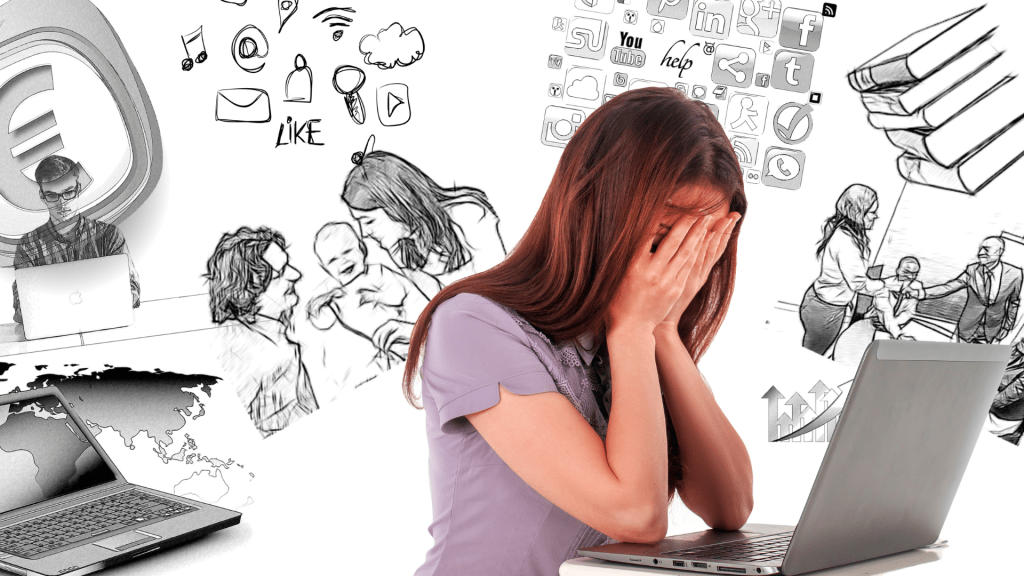
For seven years, I worked at three news stations in different parts of the country. As a news producer it was my job to handle everything, and I mean everything. From conceptualizing and executing the show, to writing the scripts, to designing the graphics, to assisting anchors, to troubleshooting tech issues in the field, it was nearly impossible to complete everything that needed to be done in only 8 hours— and that’s if nothing went wrong. To this day, the term breaking news still gives me anxiety, but it was always something I had to be ready for at work. To do this job, and do it successfully, you have to be able to manage many tasks at once, or in other words, you must be an expert multitasker.
For most of my career, I thought being a multitasker was a superpower. I bragged about my ability to balance so many things at once. In fact, I used this as a selling point in job interviews. It wasn’t just me. Most of the jobs I applied for required someone who could multitask and it was often a question that came up in interviews. Employers think that this ability to multitask is valuable because it supposedly leads to increased efficiency and productivity in the workplace. Multitasking is a concept that was initially used to describe supercomputers in the 1960s (Hari 37). These machines had more than one processor so they could do more than one thing simultaneously, so why did we (humans) apply that concept to our own lives when we only have one processor, our brains?
In reality, multitasking comes with a hefty price tag and it can be detrimental to our cognitive functionality. I have experienced the effects first-hand. I remember suffering from anxiety attacks– chest pain, heavy breathing, clamminess, after a night of intense multitasking. There’s also another factor that contributes to these physical manifestations of anxiety: task-switching. I spent many nights at work suffering from “the creativity drain,” which Johann Hari defines in his book Stolen Focus: Why You Can’t Pay Attention. When we spend so much time switching between different tasks and correcting inevitable errors that happen along the way, there is no time left to form new creative thoughts, which is an important function of many jobs.
Multitasking, and the harmful effects tied to it, is not a new concept, however, digital distractions have only elevated the consequences. Ask yourself, how many times have you looked at your phone while reading this blog? Have you checked your work email? Are you thinking about how many likes your Instagram post has received? Compile those distractions, with the multitasking we are doing at work, and our brains are massively overloaded. While there may be no definitive solution to this problem, an obvious alternative is to train ourselves to live in a “monotasking world,” meaning focusing on one thing at a time. The only question is how do we do that, when the world around us is moving so quickly?
Works Cited:
Hari, Johann. Stolen Focus: Why You Can’t Pay Attention. Bloomsbury Publishing, 2023.
 Allison Lucas
Leave a comment