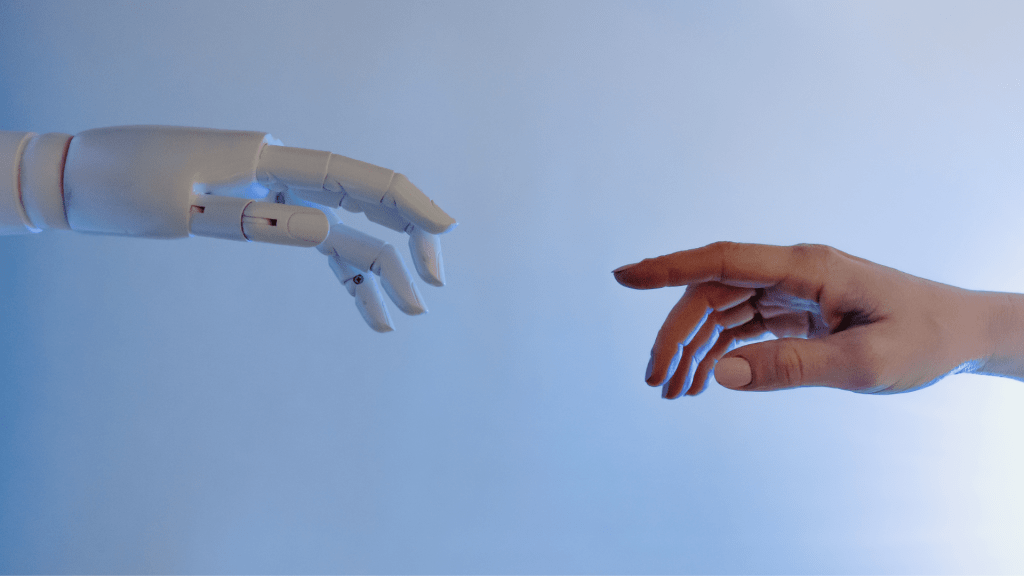
My feelings about artificial intelligence have always been mixed. When I first heard about this technology, my initial reaction was I hate this. I love to write, so when someone told me that a program called ChatGPT could write my content for me, I felt annoyed. When I learned that AI could assist with design and video work, I started to panic. Does that mean my future jobs as a creative are in jeopardy?
I was ready to shut the door on AI until I started seeing headlines about some of the benefits of this controversial technology; it can reduce human error, act as a safety net when a job is too dangerous for humans, and improve efficiency, just to name a few. It can even advance medicine, such as creating personalized treatment plans for cancer patients (NIH). Not to mention, it can lead to deep work and serve as a catalyst for creativity because it removes a lot of the “shallow tasks” that humans manage (Medium). Throughout my research, I landed on an article from Forbes that dove into key benefits of AI, which had me rethinking my first impressions of this technology, until I read the last paragraph of the article: “Now it is crystal clear that AI has all the ability to surpass human intelligence and can perform any particular task much more accurately and efficiently.” I found myself lingering on that phrase “surpass human intelligence.” This concept felt all too familiar. In Johann Hari’s Stolen Focus: Why You Can’t Pay Attention and How to Think Deeply Again he references a conversation he had with former Google engineer and Co-Founder of the Center for Humane Technology, Tristan Harris. Harris said we are seeing “a collective downgrading of humans and an upgrading of machines (Hari 141).” As of now, AI can’t replace some of key human characteristics— making moral judgements, showing empathy or compassion, or even initiating a project idea, however if we are not careful, that could change.
I’m not suggesting that advancing technology is bad, it is how we use that technology that is concerning. Peter Parker’s uncle said it best, “With great power comes great responsibility,” but unfortunately humans have a history of taking technology advances too far. If we look at social media, the original versions of these platforms started as ways to connect people but over time triggered negative impacts such as mental health issues, detriments to focus, and threats to our information ecosystem. As a society, we are currently dealing with the spread of misinformation and disinformation — AI will only exacerbate this issue. For example, in 2019 an AI-generated video of world leaders singing John Legend’s “Imagine” was released. Since then, more convincing “deep-fakes” have been released, an example of how AI is a dangerous weapon against truth, if not used properly.
The solution might seem obvious— all we have to do is control how we advance AI but self-control is not a natural human behavior. When we want something it takes a lot of effort to convince ourselves not to go after it. I think being aware of the tradeoffs of this new technology and conducting thorough research will be the key to preventing it from getting out of hand.
Works Cited
Forbes Magazine. (2023, August 24). Advantages of artificial intelligence (AI) in 2024. Forbes. https://www.forbes.com/advisor/in/business/software/advantages-of-ai/
Rao, S. (2024, February 8). AI: The unseen ally in mastering deep work. Medium. https://skooloflife.medium.com/ai-the-unseen-ally-in-mastering-deep-work-f4f836e1ec47#:~:text=In%20the%20realm%20of%20productivity,processes%20and%20enhance%20our%20focus.
The Tradeoffs of Technology. Participate. (n.d.). https://app.participate.com/assignments/module-1-setting-the-stage/f7514ee2-1433-45b3-949c-2eb88077abb1#chapter-2
U.S. Department of Health and Human Services. (2024, July 9). AI tool predicts response to cancer therapy. National Institutes of Health. https://www.nih.gov/news-events/nih-research-matters/ai-tool-predicts-response-cancer-therapy
 Allison Lucas