When it comes to social media — one size does not fit all. Each platform has a unique audience, key features, and best practices, which means it’s important to tailor your content strategy for each. It would be easy to plug in one caption and one piece of content to every social media platform, but the results would not be ideal.
Let’s take a closer look at this concept. In my graduate school class, Writing for Interactive Media, at Quinnipiac University, I am working on a long-form article for medium.com. This article focuses on the impact of the binge-watching model of consuming television on the long-term success of streaming companies and the impact it has on viewers. What is binge watching, exactly? It means watching multiple episodes of a show in one sitting; a practice that is embedded in our culture.
In order to generate interest and drive people to my article, I will need to publicize it across social media platforms.
Here’s an example of what I would post on Instagram:

“Just one more episode 📺 — I have time.” Sound familiar? Binge-watching isn’t just an addictive habit; it’s a cultural phenomenon fueled by a never-ending ‘content war.’ Companies are racing to keep up with the demand — stretching their resources. For us as viewers — it means an absurd amount of hours in front of the screen. Click the link in my bio to find out the unsettling truths behind binge-watching. 🔗
#BingeWatching #StreamingCulture #DarkSideofStreaming
There are several reasons why this post works for Instagram. First, it uses a conversational tone and an attention-grabbing first sentence, which aligns with Instagram’s casual culture. My audience consists of mostly millennials, making this post very relatable to the audience. I chose this photo because it is simple and easily recognizable. The post features emojis and relevant hashtags to help it stand out and populate across feeds (Cox 2016). Most importantly, there is a call to action. Telling people to click the link in my bio encourages them to keep engaging with my content.
Let’s look at LinkedIn:
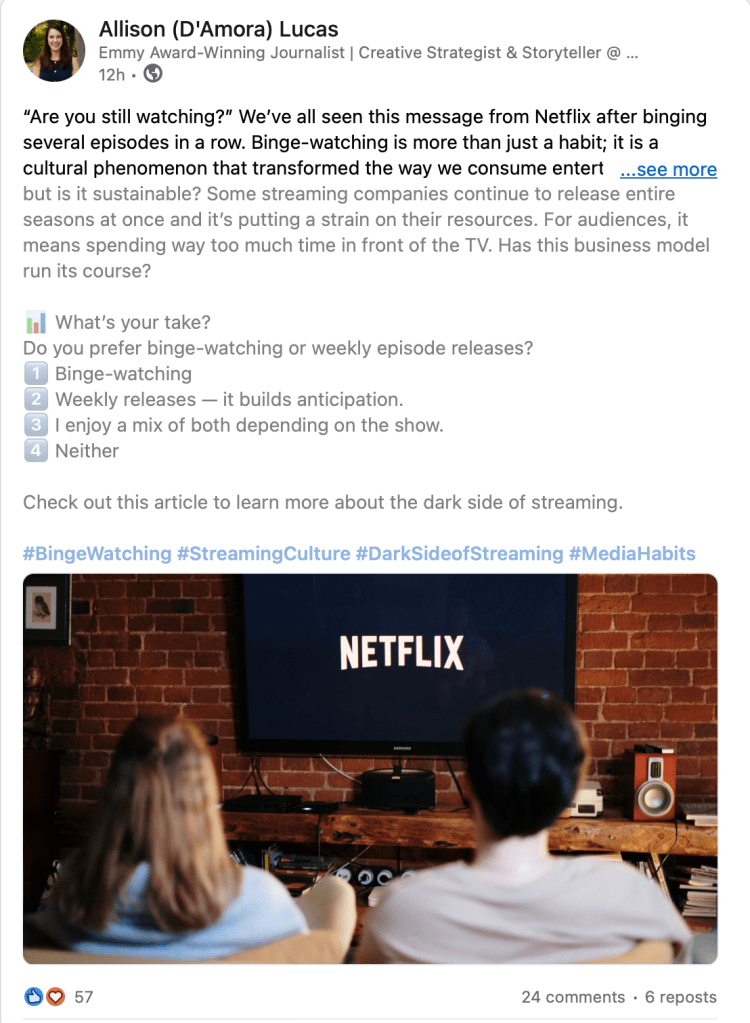
“Are you still watching?” We’ve all seen this message from Netflix after binging several episodes in a row. Binge-watching is more than just a habit; it is a cultural phenomenon that transformed the way we consume entertainment — but is it sustainable? Some streaming companies continue to release entire seasons at once and it’s putting a strain on their resources. For audiences, it means spending way too much time in front of the TV. Has this business model run its course?
📊 What’s your take?
Do you prefer binge-watching or weekly episode releases?
1️⃣ Binge-watching
2️⃣ Weekly releases — it builds anticipation.
3️⃣ I enjoy a mix of both depending on the show.
4️⃣ Neither
Check out this article to learn more about the dark side of streaming.
#BingeWatching #StreamingCulture #DarkSideofStreaming #MediaHabits
So why does this work? First, the writing is less casual and more business-professional, which aligns with LinkedIn’s culture. The writing also caters to my audience, which is a much wider range of ages and backgrounds. I also used a poll to increase engagement, which according to LinkedIn, garners 2.1 to 2.9 times more reach (LinkedIn, 2023). I chose this photo because it illustrates my topic without distracting the viewer from engaging with my link and my poll.
Finally, let’s look at X (formerly Twitter):
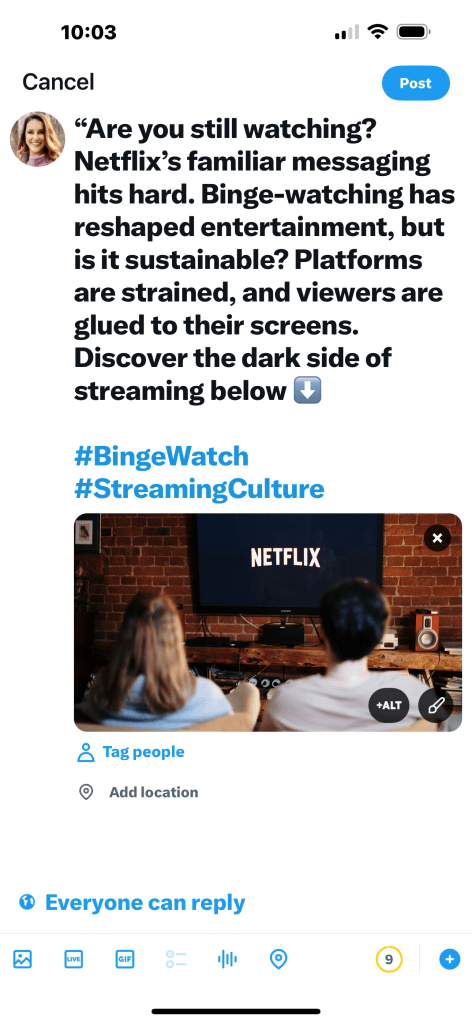
“Are you still watching?” Netflix’s familiar messaging hits hard. Binge-watching has reshaped entertainment, but is it sustainable? Platforms are strained, and viewers are glued to their screens. Discover the dark side of streaming below.
#BingeWatch #StreamingCulture
Short, sweet, and to the point. That’s the name of the game when it comes to ‘X.’ I’ll be honest, the original Tweet was much longer and wordier. Once I pasted it into X, I realized I was over the character count and needed to make some cuts.
It is also important to limit the number of hashtags to one or two. In this case, I chose #BingeWatch and #StreamingCulture because they aren’t so generic that my Tweet won’t get any attention but they are also not too narrowly focused. I also included a clear call to action to get people to click on my article (X, n.d). I included the photo that will likely be the featured image on my medium.com article, once it is published.
Works Cited
Cox, L. K. (2016, May 27). How to write good Instagram captions: 9 bookmarkable tips for perfecting your copy. HubSpot Blog. https://blog.hubspot.com/marketing/write-good-instagram-caption
LinkedIn Training for Brands, B. (2023, May 2). What to post on linkedin in 2023: 5 types of content you should create. What to Post on LinkedIn in 2023: 5 Types of Content. https://www.linkedin.com/pulse/what-post-linkedin-2023-5-types-content-you-should-create/
Organic best practices. X for Business. (n.d.). https://business.x.com/en/basics/organic-best-practices
 Allison Lucas